
By Fathiu Jimoh
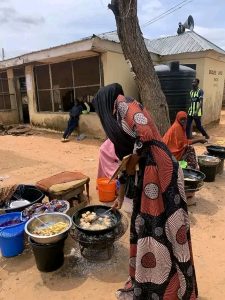
As the sun slowly creeps over the sandy soil of Usmanu Danfodiyo University Sokoto (UDUS), a familiar smell fills the air around Jubril Aminu Hostel. It is the scent of hot oil, fried potatoes, and fresh awara. For many students, it signals more than breakfast. It signals survival.
For Muheeb Au Talib, a 200-level Mass Communication student, the smell of Dankeli de Awara is a daily reminder of adaptation.
Like many fresh students, Muheeb first encountered Dankeli de Awara through word of mouth. At the time, he did not understand the excitement around it.
“The first time I heard people talking about it, I didn’t really get it,” he recalled. “I later found out it was just a local snack. I didn’t think there was anything special about it.”
That perception changed quickly when his foodstuffs finished.
“When my foodstuff finished, I didn’t even notice when I became a regular customer,” he said. “I had no choice but to adapt. I started buying Dankeli almost every night, sometimes even in the morning before lectures. It became part of my daily life.”
A Student-Friendly Lifeline
Made of fried potatoes (Dankeli) and soybean curd (Awara), the snack caters to the realities of campus life in UDUS. While some call it a snack, many students describe it as a full meal.
On a campus where allowances are shrinking and food prices are rising, Dankeli de Awara offers relief for the students. With as little as ₦200, a student can eat, regain energy, and continue the day.
Among UDUS students, it is difficult to find someone who has never eaten it. Expensive snacks like shawarma have gradually disappeared from students’ daily options, becoming occasional luxuries rather than routine meals. In response, students have turned to local, affordable alternatives.
Over time, Dankeli and Awara moved beyond just food. On campus, it earned a nickname: “UDUS shawarma.”
When Shawarma Was Not Shawarma
Zainab Usman, a final-year Chemistry student, remembers how the term first confused her.
“When I was coming to UDUS, I thought I would see places selling shawarma, ice cream, and other fancy things like off campus,” she said. “But what I saw were local shawarma joints, Dankeli de Awara.”
“One day, my boyfriend told me he wanted to buy shawarma for me. I was very excited. But what he brought was Dankeli and Awara,” she said.
Confused, she questioned him, “I asked him where the shawarma was, and he said, ‘Is that not what I gave you?’ I was speechless.”
According to her boyfriend, that moment helped cement the phrase.
“We now call Dankeli de Awara our own shawarma,” Zainab said. “After a while, it felt just as satisfying, and the name stuck.”
Adapting to Economic Reality
For many students, the popularity of Dankeli de Awara reflects deeper economic pressures. Adekolate Habeebat, a 300-level student, believes the snack mirrors the financial reality of campus life.
“Even Dankeli de Awara is becoming expensive now,” she said. “Some guys even use it as an excuse not to buy real shawarma for their girlfriends.”
However, Habeebat admited that she still enjoys it.
“Especially with pepper and groundnut oil. Once I eat and drink water, I’m satisfied.”
Abdulrasheed Naheem, a 100-level Law student, sees the snack as a lesson in financial discipline.
“My brother advised me to go for Dankeli and Awara whenever I don’t feel like cooking,” he said. “It’s better than wasting money on biscuits and soft drinks. It has really helped me manage my money.”
More Than Food: A Campus Economy
Beyond student survival, Dankeli de Awara has grown into a thriving micro-economy around UDUS. Vendors around Benji Hostel, Beji, Shama village, and the School Mini Mart rely heavily on student demand.
Mayam Ango, a vendor near Beji Hostel, described the rush during school sessions.
“The way students rush to buy it is amazing,” she said. “On a good day, I can make over ₦30,000. Even on slow days, I still earn between ₦10,000 and ₦15,000.”
During school breaks, business slows significantly.
“When students leave, we also pack up and wait for resumption,” she said. “Students are our major customers.”
Halimat Sadiyat, another vendor around Benji Hostel, shared a similar experience.
“On busy days, I make over ₦40,000,” she said. “I start selling around 9 a.m. and sometimes close by midnight. This business has helped me grow financially.”
At the School Mini Mart, Safiyat highlighted another side of the trade—the social connection.
“Selling Dankali de Awara has brought me closer to students,” she said. “I’ve built strong relationships and learned how to communicate with different people. This hustle is now my livelihood.”