
By Shehu Uthman
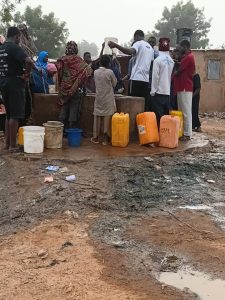
For months, the residents of Shama and Binji hostel in Usmanu Danfodiyo University Sokoto (UDUS) have been experiencing a prolonged power outage which is affecting their daily and academic activities.
Saka Maimunat, a student of Physiotherapy, said the blackout has had both academic and economic consequences for her. According to her, the lack of electricity affects her ability to study and remain informed about academic activities.
“Every afternoon when I’m supposed to revise my notes, I’m always on campus charging my phone,” she said.
Maimunat explained that the power outage has also disrupted water supply in the area, forcing her to spend significant time fetching water daily. She said this routine often leaves her too tired to study at night, which is her preferred reading time.
“It is affecting me academically because I have to fetch water every day, and the place is far. By the time I return, I’m usually too tired to read,” she said.
She recounted an incident where she missed an update about a cancelled lecture in her class group because her phone battery had died. According to her, she went to the Faculty of Law for a class only to discover it had been cancelled earlier.
“My phone battery died, so I didn’t see the update that the lecture was cancelled. I rushed to the venue and later found out it wasn’t holding. If my phone hadn’t gone off, that wouldn’t have happened,” she said.
Students Spend Hundreds Daily on Charging
Yusuf Maryam Abbas, a 100-level student of Medicine and Surgery, also complained about the prolonged blackout at Shama hostels. She said the absence of electricity has worsened water scarcity and increased daily expenses.
“If there is no light, there will be no water. Water is essential for our daily activities,” she said.
According to her, students now depend on commercial charging centres, where they now spend between N400 and N500 daily to charge phones and power banks.
“Imagine spending N400 to N500 every day just to charge gadgets as a student,” she said.
Maryam added that students who prefer reading at night now rely on rechargeable lamps, which often do not last through the night.
“After a few hours, the lamp goes off. That affects many of us academically,” she said.
She appealed to relevant authorities to intervene. “I hope this gets to the right authorities so something can be done. The situation is unbearable,” she added.
‘We Have Never Experienced Light Since Arrival’, New Student
Abdul-Azeez Basheerat, a first-year student of Human Medicine and a Benji resident, said she has not experienced electricity since moving into the hostel.
“There are sockets in our rooms, but they are not functional because there is no light,” she said.
Basheerat said she spends N200 daily to charge her phone and N300 to charge her power bank, which she described as financially burdensome.
“Think about how much that amounts to daily and compare it to how much our parents send us,” she said.
Rent Paid, Yet No Electricity
Abdulrazak Shola, a Computing Science student and resident of Shama, said he paid N100,000 for accommodation after being assured of stable electricity, but still incurs daily charging costs.
“I still spend money every day charging my phone despite paying N100,000 for accommodation,” he said.
According to him, residents also pay N1,000 monthly as NEPA fees without electricity supply.
“They usually say the transformer is faulty and ask us to contribute money. Even when we do, nothing changes,” he said, adding that he has not experienced electricity since last semester.
Owale Olamilekan, a 500-level Agriculture student and Benji resident, shared a similar experience. He said he paid N60,000 this year after being promised that electricity would be restored.
“We no longer pay NEPA bills because it makes no difference,” he said.
Students Rate Power Supply ‘Zero’
Ammar Ahmad (not real name), a student of Islamic Studies and a Benji resident, rated electricity supply in the area as “zero percent.”
“There is no light at all,” he said.
Another student, Mansur Tokora-Ummi (not real name), a Mass Communication student, rated the supply at 10 percent, citing unstable current whenever power is available.
“The low current damages our gadgets. Chargers and sockets get spoiled,” she said.
Authorities Blame Transformer Overload
Responding to the complaints, Prof. Shehu Yahaya Tsagem, the Dean of Private Hostels, said the blackout began after a transformer serving the hostels developed faults.
“The transformer got damaged, and efforts are ongoing to resolve the issue,” he said, adding that repairs have cost millions of naira.
Sanusi Dahiru, the Private Hostel Caretaker, attributed the frequent transformer breakdowns to overloading caused by students’ use of high-power appliances.
“Electric cookers, fridges, and hot plates exceed the capacity of the transformers,” he said.
According to him, N1.6 million was spent on the first repair and N1.2 million on the second. The transformer is currently undergoing another repair, with rent contributions being sought to offset costs.
He also noted that some students left electrical appliances in their rooms during holidays despite warnings.
Dahiru appealed for patience and assured the students that efforts are ongoing. “The delay is not intentional. The issue will be resolved as soon as possible,” he said.