
By Rasheedat Abidiesin
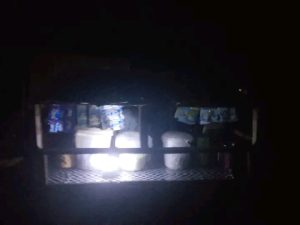
The resulting light from the working small generator illuminated Faisal Murtala’s shop. He was standing at the front of his shop when this reporter walked up to him. As darkness envelopes the Caliphate sky, Faisal could not help but smile as students would soon come to patronize his Sharwama spot.
Nestled in the heart of the northeastern part of the Niger area, Usmanu Danfodiyo University, Sokoto (UDUS), prides itself as the most peaceful university in Nigeria. The school had its students locked with a fascinating taste of the northern delicacy during the day. Yet, getting something enticing to eat in the night most times becomes a herculean task.
“Normally, I am usually open from morning, but the market usually troops more in at night time,” Faisal explained to our reporter.
He stated further that he makes up to ten to fifteen thousand naira in profit daily, depending on what the market is saying.
“Aside from this business, I’m a student. In fact I started the business just for fun, nothing serious. But I love how it’s turning out,” he explained.
Faisal whined to our Reporter that on a normal day, he closes around 12am. “However, during exams period, I am always here till 3am.”
Like Faisal, Shamsudeen Abubakar is another entrepreneur beautifying the night time economy in UDUS. His Fura spot does not only ensure that students have options beyond the Denkeli de awara (Fried chips and cheese) that they are known for. His Fura ensures no student goes to sleep without having something to eat.
Shamsudeen was grinding Fura in his makeshift grinding machine when our reporter met him, ignoring the cacophony of voices, he told this reporter that he only closes when the Fura finishes.
“Normally I am open by 11 am but I’m here at night as well. I always close my shop when my Fura finishes,” he explained.
Like Faisal, Shamsudeen sells during the day, but they realize that selling during the night can increase their income.
Additionally, Traders like Shamsudeen highlighted low patronage and fake transfer as some of the challenges that kept him at bay from staying longer in the night. He however pleaded with the school management to invest in solar street lights around the campus so as to encourage start ups and help them thrive.
“If the school management can help us with street lights that brightens everywhere, especially around the hostel minimart, it will help the sellers on campus to stay longer in the night,” he said.
“As you can see, I’m just making use of the light from my generator. If I’m not grinding, everywhere will be pitch dark,” he ended.
The Night Economy
The night-time economy is a significant and growing part of the global economy, up until the coronavirus- induced lockdown changed the structure of the world economy in 2020.
In the United Kingdom, the night-time economy was in 2019 considered the fifth-biggest industry, accounting for at least 8% of the UK’s employment and annual revenues of £66bn, according to the Night Time Industries Association.
The growth in business activity at night-time was so phenomenal that the Mayor of London was prompted to appoint TV presenter and performer, Amy Lamé, as London’s first “night czar” in 2016.
In the United States, the night-time economy in New York generates $35.1bn (£27bn) in economic activity, and nearly $700m in local tax revenue.
In the last decades, many cities across the world have devised ingenious means that would ease the running of the 24-hour economy and allow socio-economic activities take place round the clock unhindered by nightfall.
“The barrier for major cities in most developing economies is that policies and facilities to drive the evening economy are usually not in place, and that’s why we lose so much in revenue,” says Zainab Abdullahi, an economist from Kwara State.
“The night economy requires policies and structures. Leading countries of the world are working round the clock to ensure that basic policies cater essentially for night time economic activities because they understand how important it is to generate revenue,”
In Nigeria, poor infrastructure and widespread insecurity have made it near-impossible for cities to operate the night economy, leading to massive loss of potential revenues by state governments.
Investments That Never Was
Sulaiman Fatimah, a graduate of UDUS who came for her transcript could not help but shake his head. She reminisced how UDUS used to feel like, and how ‘Ten Ten’—UDUS top restaurant then— served them with sumptuous meals.
“It was really a good time during our time, but then suddenly the restaurant stopped functioning. It is really a pity,” Fatimah lamented.
Just a stone’s throw from the Students Union secretariat, narrations have it that, ‘Ten Ten’ the restaurant Fatimah mentioned, used to be one of UDUS top restaurants. According to sources, Ten-Ten folded because of some issue it had with the school management. Our Reporter was unable to confirm this because of inability to reach its former owners.
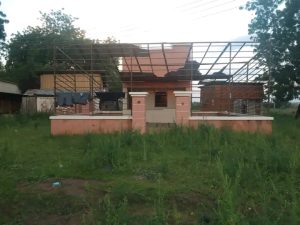
While the structure of the fast food joint still stands in its skeletal form, the overgrown weeds covering the surface makes it a perfect hide out for illegality. Digest can confirm that smokers do stay there in the night to smoke.
“Tush Barbecue also vanished like it never had a stand on this campus. These days, I have been seeing another person selling puff puff at a place that used to cook barbecue to our mouths,” Abdullateef Suleiman, a 200 level student pointed out.
Jemilu Qadri (not real name) told Digest about how impossible it is to have choices of what to eat at night in UDUTH.
“In UDUTH here, once it is dark and you cannot cook, you either eat snacks or other junk you get around, or you starve till next day,” he whined.
Soliu Qadri, a 200 level student no longer sees Denkeli de awara as a healthy meal for himself. His patronage has spoiled his taste board to the extent that each time he tasted the life saving delicacy, he felt like he was chewing the white metro.
“At some point I started craving something different at night, because I can’t cook. Thank God the fura guy is back,” he retorted.
The Setbacks
For Faith Ajayi, her culinary skill is one thing she would love to put to use to build her finances. Each time she cooks, her friends admire each delicacy she brings to the table.
“I decided to start making noodles at night, but when the lack of patronage wanted to bankrupt me, I couldn’t continue again,” Faith pointed out.
“I only wanted to start doing something different from what you get from this Mashai. But even my own friends that were hailing my cooking do not patronize me.”
It is one thing to have an idea, it is another to get people to patronize you,” she ended.
The Benefits
Zainab Abdullahi explained that, if students could cultivate the habit of selling goods or rendering services that people need in the night, “It not just helps in promoting their own finances, it helps in boosting the economy in their university communities,” she ended.
This story was completed with support from Digest Press.