
By Hauwa’u Malami
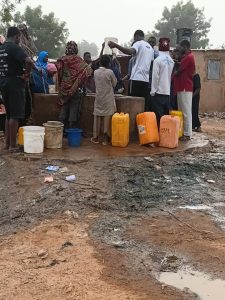
As the morning sun peeks out from behind the clouds, Mahmud Mudi, a resident of “80k” Hostel in Shama, puts on a worried look. The reason for this is obvious: the 200-level veterinary medicine student, every morning, carries with him some of his empty jerrycans and goes ahead to queue together with other students like him, struggling to get water. To him, his first daily challenge is finding water, not books.
Speaking with DIGEST PRESS on a Monday morning, he said the water in his 80k hostel depends almost entirely on electricity, which is not even stable.
“Electricity is our main source of getting water, and without it, life becomes difficult,” he said, shaking his head.
Mahmud added that despite all the promises and discussion with the relevant authorities, they nevertheless continue struggling with water.
A National Crisis
Mahmud’s story is not an isolated one. According to the World Bank, In 2018, Nigeria’s Water, Sanitation, and Hygiene (WASH) sector was declared to be in a state of emergency by the government. The report shows that approximately 60 million Nigerians were living without access to basic drinking water. The report also added that 39% of households lack access to at least a basic water supply.
The consequences of water scarcity have been answered by UNICEF: water scarcity limits access to safe water for drinking and for practicing basic hygiene at home, in schools, and in health-care facilities. When water is scarce, sewage systems can fail, and the threat of contracting diseases like cholera surges. Scarce water also becomes more expensive. When water is further away, it requires more time to collect, which often means less time at school. Carrying water long distances is also an enormous physical burden and can expose children to safety risks and exploitation.
Daily Struggle for Survival
The story is the same for Imam Abdullahi, a 200-level English student residing in Darulsalam Compound, Shama area; he described the search for water as a journey filled with uncertainty.
“There are days you step out with your bucket, hopeful, only to come back disappointed, without even a single drop of water,” he told Digest.
According to him, the distances students cover just to fetch water are draining, especially under the Sokoto sun.
“Sometimes we trek as far as the Veterinary Department. By the time you return, tired and sweaty, you have already lost the energy meant for lectures,” Imam narrated.
Imam explained that the shortage often disrupts daily routines, as cooking is delayed, bathing is hurried or sometimes completely skipped, and even getting ready for school becomes an added struggle.
For Hamza Malami Ahmad, a political science student at Jafar’s Compound, water scarcity is not only physically draining but also financially crippling, pointing out that buying water has become an unavoidable burden.
“A gallon of water costs 50 naira, and if someone is paid to carry it, it adds another 100 naira,” he explained.
According to Hamza, some students attend lectures hungry and sometimes unbathed, just because water was simply not available.
Different Path, Similar Story
With the beginning of a new academic session, the introduction of a solar-powered water supply raised hopes among Benji and Jamila’s private hostels. But the relief has been inconsistent.
Nusaiba Salis, a 200-level microbiology student, said the system brought improvement but also new frustrations.
“There are days we still go without water for long hours. Sometimes the supply is diverted to other hostels, leaving us stranded.”
She added that water often flows during lecture hours, when most students are away.
“You return tired, hoping to bathe or cook, only to meet dry taps,” Nusaiba said.
‘It Is Not Just Pipes, It Is People’
Hussaini Bello, who oversees water control and shifting for Benji and Jamila Compounds, explained the problem is not only technical but also human.
“We try to follow a schedule. But whenever water is redirected, some people shut it off unfairly and direct it to their compound,” he noted.
Malam Hussaini stressed that without cooperation, no system, electric or solar, can work efficiently.
“All houses need to sit down and talk. There must be understanding. Without that, the crisis will continue,” advised Malam Hussaain.
Management Responds, Pledges Further Action
Reacting to the growing concerns over water scarcity, the management of the Shama compound, one of the affected compounds, says it has begun taking steps to ease the hardship faced by students recently after receiving complaints.
The caretaker, Nafi’u Bello, confirmed that an emergency intervention had already been made by deploying a generator to one of the affected houses to pump water.
“With Ramadan approaching, we cannot allow students to be fasting and still trekking long distances just to get water,” he said.
He added that while the generator provides temporary relief, the management will continue to explore more practicable solutions to ensure consistent water supply across all hostels.