
By Hauwa’u Malami
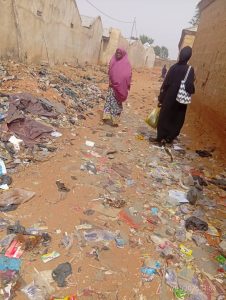
Every morning, before Sadiq Dahiru Kanoma, a 200-level Law student of Usmanu Danfodiyo University, Sokoto (UDUS), steps out for lectures, he is confronted by the stench of decomposing refuse rising from piles of waste near his hostel.
Sadiq lives in a private hostel behind Benji Mosque in the Shama area, a location populated largely by UDUS students. He said the refuse dumps surrounding the area have been a constant feature since he moved in over a year ago.
“I can’t say exactly when it started, but throughout my one year of staying here, it has always been like this. You see similar conditions in other parts of the school,” he said.
According to him, living close to unmanaged waste has affected both his physical comfort and mental wellbeing.
“The air is polluted, and the smell is disturbing. Constant exposure to this kind of environment is mentally draining and can affect one’s health,” he added.
A campus Problem Reflecting a National Crisis
Sadiq’s experience mirrors a big sanitation challenge across Nigeria. Data from Clean Up Nigeria (CUN), an international non-governmental organisation, have exposed that more than 176.3 million Nigerians lived in unclean environments in 2022 alone, up from 172 million in 2021, out of an estimated population of 250 million of the citizens
Similarly, the World Bank reports that Nigeria generates at least 32 million tonnes of solid waste annually, a figure projected to rise to 107 million tonnes by 2050. Yet only about 30 per cent of this waste is properly collected and disposed of, largely due to weak waste management systems, especially in low-income and peri-urban communities.
Within university environments like UDUS, the students say these systems are being reproduced in private hostels that house thousands of undergraduates.
Public Health Risks Lurking in Plain Sight
According to the World Health Organization (WHO), poor sanitation plays a major role in the spread of preventable diseases such as cholera, typhoid, dysentery, intestinal worm infections, and polio. Prolonged exposure to unsanitary environments also worsens antimicrobial resistance and contributes to respiratory illnesses.
Meanwhile, a 2021 World Malaria Report confirms that Nigeria, Africa’s most populous nation, remains the most malaria-endemic country in the world, accounting for 27% of cases and 32%
Public health expert Adaeze Ngwakwe, based in Ibadan, described told theWhistler that refuse dumps as a persistent global threat.
“Unengineered dumpsites expose residents to hazardous chemicals. Studies show higher concentrations of harmful air pollutants near dumpsites, increasing the risk of asthma and chronic respiratory diseases,” she said.
There is no System
Students interviewed around Shama area consistently blamed the problem on the absence of a structured waste disposal system. For example, Christiana Nwankwo, a 100-level MBBS student living in Jamila House opposite Benji girls hostel, described the environment as unhealthy.
“There are mosquitoes everywhere, dirt everywhere, and no place you can say is waste-free,” she said.
Though she has not suffered serious illness yet, Christiana said the situation has already increased her living costs.
“In just one week, I’ve used more mosquito repellents than a normal household would use in a month,” she said.
Like Christiana, Shalon Honest, a final-year Pure and Environmental Chemistry student, said there is no designated refuse point around her hostel.
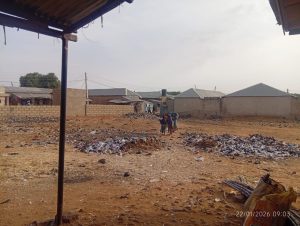
“Everybody is acting on their own because there is no rule or specific place to drop waste. During the rainy season, the smell becomes unbearable,” she said.
A visit by this reporter to the Shama area confirmed these claims. Refuse piles were observed within compounds and along walkways, emitting strong odours and attracting insects, indicating a lack of formal waste collection.
Paying More, Getting Less
Despite paying significantly higher fees than students in on-campus hostels, private hostel residents say they receive little in terms of sanitation services.
While university hostels such as FBI, Zamfara, D.V, and Bakassi charge about ₦25,000 per session, many private hostel residents pay far more but live amid unmanaged waste.
Uzaifa Iskak Arafi, a 100-level Geology student, said students sometimes worsen the situation but blamed weak regulation.
“When waste piles up, we throw it wherever we can because there’s no designated spot. We follow what others are doing,” he said.
Jemimah Simon, a 400-level Political Science student living in an 80k, Shama private hostel, blamed landlords and poor oversight.
“If landlords provided proper bins or dump sites, things would improve. Some students also behave carelessly, dumping waste openly,” she said.
In her compound, residents resort to burning refuse monthly.
“It’s not good, but it’s better than letting waste pile up endlessly,” she said.
Environmental and Climate Implications
A climate advocate and 500-level Agricultural Economics student, Summaiyah Ojonugwa Shuaib, has warned that improper waste disposal has long-term environmental consequences.
She explained that organic waste decomposing without oxygen releases methane, a powerful greenhouse gas, while burning waste releases carbon dioxide and black carbon, worsening climate change.
She added that burning plastics releases toxic substances that contaminate soil and water, reduce soil fertility, and harm the ecosystems.
‘We Clean, But Students Litter Again’— Private Hostel Caretaker
Speaking to Digest Press, Sanusi Dahiru, the caretaker of 80K Shama Private Hostels, denied claims that waste management is entirely neglected, blaming persistent littering by students for the worsening conditions.
“We clean regularly, but before we even finish, students start littering again. It is very stressful,” he said.
He added that designated waste points exist for both male and female residents, but many students ignore them and dump refuse indiscriminately.
Sanusi also revealed plans to create a central dump site at the back of the hostel where all waste will be collected and later cleared or burnt when necessary.
“We plan to create a central dump site at the back of the hostel where all waste will be disposed, and cleared when full, or burnt if necessary,” he added.
Student Union and UDUS Management Pledges Actions
The SU-CTC Social/Welfare Director, Fatima Zarah Muhammad, said the Union is aware of the situation but has not received formal complaints.
“Our role is to communicate students’ concerns to the school authority, especially since these are private hostels,” she said.
The Dean of Private Hostels, Professor S.Y. Tsagem, said the university engages hostel landlords on sanitation issues each session.
“We remind landlords of their responsibilities, including waste management and general upkeep,” he said.
He acknowledged enforcement challenges but emphasized that the university remains open to student complaints.
“If you see anything, you can talk to us, and we can improve,” he added.