
Oyelowo Khalid
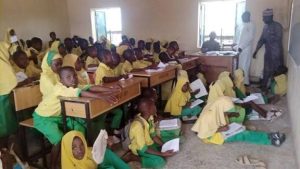
The question who fails when school fails is not a rhetorical one, it is a painful question that demands an answer. When school fails to teach, educate, and equip students with what they need to sail through their academic journey, it is not only the student who fails or loses out on what is due to them. The whole society suffers, including parents, teachers, the economy, communities, and even the government.
This essay will dig into two layers: how and why Nigeria’s public education system is failing, the consequences of that failure, and practical solutions to the current crisis in Nigeria’s public education sector.
Nigeria’s public education has been shaky for decades. According to UNESCO (2023), over 20 million Nigerians are out of school, the highest number in the world. Nigeria’s public education system is not just in crisis, there are reasons behind this seemingly undefeatable situation. Underfunding is one of the major reasons Nigeria’s public schools are failing. This is a country where the government is expected to provide free education for its people. Yet, even after building schools, necessary funds are not provided.
This is not hearsay, it is what I experienced. Back then in my primary school days, due to lack of funds in the school I attended, the ceilings of our classrooms were not strong enough to resist rain. Sometimes, we even sat on bare ground because the chairs were broken beyond repair. Anytime there was a sign of rain, even if we were just starting lessons for the day, school had to close unless teachers and pupils were willing to get drenched.
Shortage of teachers is also one of the reasons for the burning crisis in public education. Scarcity of teachers has been a major setback in Nigeria’s educational system. I did not only suffer because of underfunding in primary school, I also suffered due to lack of teachers in secondary school. We could go a whole day without any teacher teaching us. Even our principal turned the school surroundings into a farm. We went to school to learn, but we were given hoes and cutlasses instead of books and pens. Perhaps, if there were enough teachers available, things would have been better.
I choose not to blame those who refused to teach, because many of them were not given what they deserved. Most teachers, especially in public schools, are underpaid.
I believed that when I got into a federal university, my hurdles would finally end, as I had suffered in schools whose affairs were neglected. But the ASUU strike shattered my hopes. I spent eight terrible months at home. All these issues are more than enough to cause a crisis that will brutally affect Nigeria’s public education system.
When school fails, the first set of people to bear the primary burden are the students. Students fail to access opportunities for personal growth, lose self-esteem, struggle to develop problem-solving skills needed to navigate life, and become inefficient in the education they supposedly acquired. This can hinder such students from getting suitable jobs for survival. Students who are victims of poor teaching quality and inefficiency in the educational system often graduate without functional literacy and job-ready skills.
When JAMB announced the rate of failure, comparing those below 200 to those above 200, the gap between those who failed and those who struggled to pass was so wide that parents and others began questioning the efficiency of the education system. Let us also cast our minds back to the WAEC report in 2022, which showed that only 48% of candidates in Nigeria managed to obtain five credits. These are signs that show how students are failing because schools have failed to recognise the urgency of fixing their loopholes.
The failure of schools cannot be blamed on students alone. Parents also fail when schools fail. When schools fail, students fail, and obviously, parents suffer too. A situation where parents invest their scarce resources to support their children in school, only for those children to become victims of a failed educational system, it is heartbreaking. The student may not only fail to succeed academically, but the failure of the school system can also lead to intergenerational poverty, where poor education ensures that poverty does not end anytime soon in the family.
I am not surprised when some of my friends who failed their SSCE due to poor educational support joined bad gangs, while others became motorcycle riders just to make ends meet. These are people whose families and relatives relied on to lift them out of hardship. But that dream remains a dream as they watch their children struggle daily. If only time could be reversed, some parents would have invested their money in business rather than in an education system that would only worsen their standard of living.
Society also suffers a major cost. Education is known as a tool to promote societal development and strengthen civic responsibility. When the last hope of society fails, then society itself has something to lose. Society suffers from reduced progress, an increase in unemployed graduates, and a rise in crime. A school that is meant to educate students on their rights and responsibilities, especially in terms of political participation, has failed.
Students may not even know their duties to society, and even when they speak up, their voices may be ignored or suppressed. This is why political leaders continue to manipulate citizens for many years without hindrance. They believe that the majority of people in society are products of a failed school system and are therefore vulnerable to manipulation. I am not surprised when a friend’s father was killed over a “congo” of rice during an election.
When schools fail, the number of people who fail is far more than we can imagine. The government, which has played a role in the failure of the education system, will also suffer for it. Even the economy will taste the consequences. The economy will suffer because unskilled labour will flood companies across the nation, and innovation will be weak. We have seen influential people sending their children abroad because they understand the loopholes our educational system is battling.
A failed educational system produces citizens who cannot sustain national development. Schools that should teach values and speak against corruption and inefficiency have failed, meaning corrupt practices affecting the nation will not be solved but will instead be worsened. As a writer of this article, I’ll not beat around the bush. I will boldly knock the nail on the head: if schools fail, the nation itself will fail.
The second layer of this essay exposes practical solutions to the decline in value of Nigeria’s public education. A problem well-defined is a problem half-solved, and when there is a will, there is a way. The first necessary step towards reviving the education sector is teacher reform and motivation. The backbone of every educational system is the teacher. If teachers are properly compensated and supported, our public education system will bloom.
Teachers should be trained regularly to improve efficiency. They should not be underpaid. They are people of value, and they must be valued. For the sake of accountability and effectiveness, there should be teacher competence assessments. This will help to test the knowledge and readiness of teachers and determine who is truly qualified. I would not have been a victim of the eight-month strike if lecturers were treated with respect and fairness.
The government should prioritise education and increase funding for the sector. I have been a victim of a school without proper ceilings, classrooms that could not protect us during the rainy season, and learning environments that could not withstand harsh heat. These are my experiences, and they are also the experiences of many others. But if the government can normalise the renovation of old schools and provide enough funding to sustain schools and their management, progress will follow.
It is not too much to ask that we move beyond blackboards and white chalk, it’s high time we embraced technology-based learning methods such as computers, tablets, and other digital tools. Claiming that youths are the leaders of tomorrow without giving them quality education is like building a castle in the air. It is not just a dream, it is an unimaginable one.
Decentralization of responsibility within public school management would also be a great step towards tackling the crisis. It would help if schools share responsibilities with parents by cooperating with them on how to sustain a stable educational system. This method would ensure students are encouraged not only in school but also at home.
It would also ensure that parents serve as watchdogs over the system. We know there are some indolent teachers who collect salaries and do nothing. Such teachers should not be left unchecked, as parents will not tolerate laziness and negligence. When schools fail, when the educational system is in crisis, it is not only students who suffer. It is the entire nation that crumbles under the weight of ignorance, unemployment, and underdevelopment.
Education is not just a tool for social change, it is a means of securing the future that the nation depends on. If the education sector fails, the nation’s progress will fail, and its future will remain uncertain. Nigeria must therefore strategies its public education sector. There is a call for change, and Nigeria must respond. If we continue to neglect education, then in the long run, the nation itself will become the biggest failure.