
By Rasheedat Abidiesin
Abstract
From UDUS campus to Dendima, Haji Alima, and to the metropolis of Sokoto, the common sight of school–age children roaming the streets, while begging or engaging in menial jobs for survival always raised a critical question of what future beholds for the up–and–coming generation of that society. The whole North has earned a reputation for this.
“I am not attending any formal school. Instead, I am going to a Madrasah (an Islamic school). Life has been difficult since I came to this state, particularly in feeding myself. I’d have to beg before I could get a morsel of food,” this is the plight of Sani Yusuf, one among thousands of school–age children in Sokoto, and Northern Nigeria.
Although the boy has a bag full of dreams, one of which is becoming a popular Mallam (an Islamic teacher), he doubted that his current situation will make this possible. He said that he traveled several miles from Gusau, Zamfara State, to Sokoto to gain knowledge.
And whenever I travel (coming or going to school), I normally see several students in school uniforms on the streets during the school hours on the roads of Ilorin, Oyo and Saki—that is one. Sometimes, both boys and girls under the age of 19–years will be calling customers to a shopping vendor—at an hour when they are supposed to be in class receiving lectures—that is another. Can we speak of a disturbing video recently circulated online, capturing secondary school students clashing with weapons. They all speak Yoruba. Those are the plights in the Southwest.
Then what about us that go to school? Many times, we leave our hostels as early as 8:00 in the morning, hoping to return after the three scheduled lectures. If we are lucky, one lecturer could come, and spend 30–minutes. And if we are so unlucky, we go back to our various hostels as we left it. Yes! Many lecturers have justified their absence on the longstanding disagreements (such as poor remuneration) between Academic Staff Union of Universities and the Federal Government of Nigeria.
The above scenarios are few of what education has become in our dear country. Nigeria!
SCHOOL is a place meant to nurture growth, discovery, and transformation; a space where dreams are shaped and futures are built. But in Nigeria, the irony is the order of the day, from primary schools to tertiary institutions.
When schools fail to serve their purpose, they become silent factories of frustration, where disillusioned students were manufactured, and finally bearing a disappointed society. To Nigerians nowadays, the conversation is no longer focused on access to education, but about the failure of schools to deliver quality learning, sound values, and hope for a better future.
Who Truly Fails When School Fails?
When schools fail, it is not just students who carry the cross of the loss. The entire society will pay the price. You may wonder why, but everything will soon be loosely explained.
To begin with, when school failed, it’s not just the students that were denied a right, the whole system suffers. The teachers, the parents, the community, and even the entire nation will feel the ripple effect. When a broken school system produced half baked graduates, and frustrated youths, the society will continue to chase progress it will never catch. Such is the fate of Nigeria, a country that boasted itself as the giant of Africa, and the largest oil producer in the continent, yet still rated among the top countries in the world where poverty, and other societal menaces thrive with impunity.
With the education system still crawling to develop—schools were underfunded, teachers were underpaid, ridiculed and unmotivated, teaching methods were outdated, infrastructure was so poor and left in neglect. Then who is to carry the blame? As the students blame tutors, and the tutors hold the governmentment accountable.
Education, being one of the significant paths to success; the guide to prosperity, and the fuse that connects goodness with greatness, it drives ambition into accomplishment, transforms potential into performance, and lights the way from ignorance to enlightenment.
In every society and every generation, education remains the cornerstone upon which the dreams of individuals, and the progress of nations are basically built. However, all these characteristics of education seem like a paradox in Nigeria. Our educational system has been in steady decline, threatening not only the dreams of millions of young learners but also the nation’s long term stability.
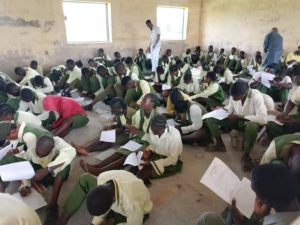
Over 50% of public primary schools in Nigeria lack basic furniture, laboratories, libraries, or toilets, a report by UNICEF and UBEC revealed. In some parts of Northern Nigeria such as Zamfara, Sokoto, and Borno, students reportedly learn under trees or in broken classrooms with roofs blown off, as classes are totally suspended during the rainy season.
Several researches have exposed how thousands of unqualified teachers remain in classrooms due to nepotism, lack of training, and poor remuneration. Also, several allegations have spotlighted numerous scandals involving diversion of Universal Basic Education Commission (UBEC) funds and ghost schools that exist only on paper.
All the highlighted points lead to a failing school system that produces a failing society, with high illiteracy rates, youth unemployment, and rising insecurity all trace back to educational neglect. A nation that cannot educate its children cannot compete globally, govern effectively, or sustain peace and progress
A Mechanism That Guarantees Education But Barely Protect It—The Nigerian Law
Under the Nigerian extant law, education is not a privilege but a constitutional responsibility imposed on the governments. Section 18, subsection 1 to 3 of the 1999 Constitution Federal Republic of Nigeria (2023 as amended), placed an obligation on the government to “direct its policy towards ensuring equal and adequate educational opportunities at all levels.”
While this governmental duty falls under Chapter II (Fundamental Objectives and Directive Principles of State Policy), it is therefore non-justiciable—making these provisions of the Constitution a toothless dog—one that has teeth but can not bite.
The above is among the major reasons that provides an opportunity for government officers in the public educational sector to mismanage and maneuver funds with impunity. This, many jurists argue that failure to provide effective schooling still amounts to a moral and administrative failure of the State.
Prof. Ben Nwabueze, and Prof. Itse Sagay have argued that the right to education should not be treated as a mere policy goal but as a binding legal right, because without it, other fundamental rights (like the right to life, dignity, and freedom of expression) cannot be meaningfully enjoyed.
In various examination centers, especially in secondary levels, Senior Secondary School (SSS) “miracle centers” have openly assisted students during exams in exchange for fees.
This culture of malpractice reflected how schools have failed to instill integrity and discipline, producing graduates who value certificates more than competence. The consequence is a workforce filled with credentials short of skills.
While the problems remain glaring, the true measure of progress lies in finding workable solutions that can rebuild confidence in Nigeria’s public schools, and restore their purpose.
What Needs To Be Changed
To begin with, education must be treated as a national investment. Proper funding is the first step toward real reform. But funding without accountability is a recipe for failure. Every Naira allocated to education must be traceable and transparently spent. Textbooks should be made available either free or on lower purchase, laboratories should be made functioning, and teachers should be paid on time. If all these are neatly met, the quality of our education is guaranteed to improve.
Another vital step is the modernization of the curriculum. Nigeria’s educational content still bears the marks of colonial design, so rigid, and outdated. To prepare young Nigerians for a changing world, the curriculum must be restructured to emphasize skills and technology.
Finally, Nigeria must cultivate political will and policy continuity. Too often, education reforms end where a new administration begins. Each government discarded the projects of its predecessor, leaving a trail of abandoned plans and wasted resources. True progress will only come when education is treated as a national priority that transcends politics.
Possible Way Forwards
Invest in teachers first. BETTER pay, TRAINING, and MOTIVATION. A teacher who’s valued will always produce BETTER students.
Modernize learning. Introduction of technology should be prioritized, practical skills, and real life problem solving, not just the everyday theory and textbooks that have left our learners unexposed.
Fix the environment. Safe, clean, and functional classrooms matter more than we admit.
Community involvement. Parents, Non Governmental Organisations (NGOs), and local leaders need to see schools as their PROJECT, not just government business.
Accountability. Education funds should actually reach the classroom, not just disappear in the system.
Notably, when school fails, everyone fails because the quality of a nation’s education determines the quality of its future.
Fixing it is not just about new policies, it’s about new mindsets, where education is seen as a collective responsibility.
CONCLUSION
Fixing Nigeria’s public education is not a mystery, it is a matter of priority, integrity, and action. The solutions are within reach: fund schools properly, empower teachers, modernize learning, and make accountability a culture. When we fix the schools, we fix the nation’s future. Because every broken classroom is
a broken promise, and every repaired one is a renewed and restored hope. Simple!