
By Hawa’u Malami
The morning air was cool and dusty when Fa’iza Abubakar hurried out of her hostel, her mind fixed on the test that awaited her. Halfway down the path, her heart skipped, she had forgotten to buy a full-scap sheet, the answer booklet she needed for the test. The 200-level English and Literary Studies student searched for the familiar kiosks that usually save students in seconds.
But that morning, they were gone.
To get a full-scap sheet, Fa’iza had to walk all the way to the school minimart, several metres away from her classroom.
“I was almost late for my test. I had to rush to the minimart just to get a full-scap sheet,” she said.
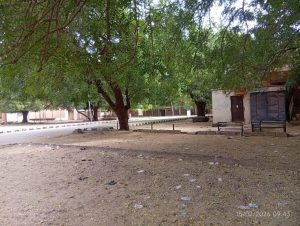
Her experience is not isolated. On the 13th of February, 2026, the university authorities, in collaboration with the school security unit, ordered the evacuation of all traders operating around corridors, walkways and open spaces. They were directed to relocate to the general minimarts across the campus.
The development has created inconvenience for both students and traders, many of whom say their livelihoods are now at risk.
Students Struggle With Access, Safety Concerns
For many students, the biggest challenge is inconvenience. Before the evacuation, traders were spread across the campus. Students could easily buy sachet water, quick snacks, phone accessories, shoes and photocopies within seconds. Now, they must walk longer distances before accessing these services.
Beyond convenience, some students say the campus now feels less safe at night.
Sakina Nuruddin, a 100-level Physiotherapy student, said the kiosks and shops added life to the school environment. The constant movement, lights from stalls and presence of people made those areas feel safer, especially after dark.
“We need the shop owners back,” she said.
Fa’iza also noted that the absence of traders has changed the campus atmosphere. “At night, it feels different. It’s too quiet and too empty. It doesn’t feel as safe as before,” she added.
Traders Battle for Survival
For traders, the situation goes beyond inconvenience, it is about survival.
One trader, Lukman Tahir, said the removal notices followed earlier meetings with university authorities where they were told not all shops would be affected. He said the situation changed suddenly when all traders, including those with properly constructed shops, were asked to vacate.
Another trader, Ibrahim Jibril, questioned the process and fairness of the decision. He suggested that minimart operators might benefit from reduced competition.
He criticised the removal of well-built shops, noting that the action has left some parts of the campus without nearby services.
According to him, if relocation was necessary, it should have been handled more transparently and in a way that would not disrupt students and traders so severely.
“If changes are necessary, they should be done fairly and properly,” he said.
‘The Place Feels Less Safe Without the Shops’ — Muri Fancy
Murtala Sa’idu, popularly known as Muri Fancy and owner of one of the most frequented campus shops, said traders are willing to comply with new regulations if allowed to operate again.
He appealed to the authorities to consider the hardship the removals have caused both students and traders. According to him, once-busy areas now feel empty and less welcoming.
“We’re ready to cooperate if proper regulations are put in place,” he said.
University Explains the Decision
Despite the concerns, the university management said the evacuation is not about favouritism. The Investment officer, Mr Sirajo Abdulrazak, said the relocation aims to create a more organised campus environment.
“The aim is to create a more organised environment. It is not about favouritism,” he said.
He explained that the removals were prompted by accreditation requirements.
“An accreditation team from Abuja observed that commercial activities were scattered across campus and directed the university to relocate businesses to designated centres,” he said.
According to him, management approved the relocation as far back as October 2024. Notices were issued to all the traders and arrangements made for relocation to the minimart and other approved areas.
He added that steps are underway to repair minimart shops, re-register vendors, enforce sanitation rules and allocate vacant spaces to displaced traders.
Addressing students’ concerns about inconvenience and security, he said such issues should be channelled through the Students’ Union Government. He added that the university plans to establish and maintain business centres across faculties.
“Students will get used to the new arrangement with time,” he said.
SU-CTC Weighs In
In an interview with DIGEST PRESS, the SU-CTC Social/Welfare Director, Fatima Muhammad Zarah, said the Students’ Union plans to address the poor lighting in the affected areas to improve visibility and safety.
“The SU is planning to do something about the darkness around those sides as the students are complaining,” she said.