

By Oyelowo Khalid
At about 10 p.m., when most students settle down to read or rest after lectures, Ahmad Ahmad, a 100-level student at Usmanu Danfodiyo University Sokoto, often sits outside his hostel room under the night sky, his silent rechargeable fan beside him and sweat running down his face.
Inside his room, the heat is almost unbearable. For Ahmad, the unstable power supply during the dry season in UDUS leaves him battling both darkness and suffocating heat.
Since resuming in November, Ahmad had developed a habit of going to lecture halls every night to read quietly. But the routine was disrupted when power across UDUS main campus became increasingly unstable.
“I stopped going to class to read because of the heat. Sometimes it feels like I might suffocate,” he said.
His struggle continues even in his hostel when he tries to sleep.
“I cannot sleep on my bed or inside my room anymore. I usually sleep outside because I sweat too much indoors. I bought a rechargeable fan, but the problem now is finding a place to charge it,” he added.
Ahmad fears the discomfort may begin to affect his academic performance as first semester examinations approach.
The Soler Fault
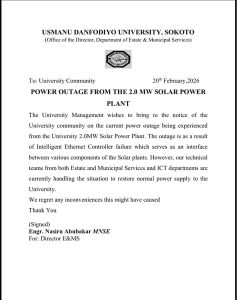
Ahmad’s plight is not isolated. On the 20th of February, 2026, the management of Usmanu Danfodiyo University Sokoto (UDUS) issued a circular informing students and other residents of a general power outage across the campus.
According to the notice, the blackout was caused by a fault in the university’s 2.0-megawatt solar power system, which has served as the primary source of electricity for the university since its commissioning in 2022.
The circular assured members of the university community that efforts were underway to resolve the technical fault and restore stable electricity supply as quickly as possible.
However, several weeks after the announcement, the situation has largely persisted. Although electricity occasionally returns sometimes for two or three hours after days of outage, this irregular supply has provided only minimal relief for students and residents struggling with the intense dry-season heat.
The Scorching Heat in Sokoto
The electricity crisis has become even more difficult for students because of the intense dry-season heat in Sokoto State, widely regarded as one of the hottest regions in Nigeria.
According to weather forecasts, daytime temperatures in Sokoto during March often range between 38°C and 40°C, with heat levels sometimes feeling even higher under direct sunlight.
When Power Outage Drains Students’ Finances
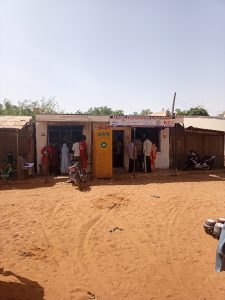
Aisha Daud, a 300-level law student residing in Kano Hall, said the unstable electricity has made hostel life particularly difficult.
She explained that keeping her rechargeable fan powered has become a daily priority, even if it means leaving her phone uncharged.
“Sometimes I leave my phone and charge my fan instead,” she said. “There is always limited space at the charging centre.”
According to Aisha, she spends ₦150 daily just to charge her fan.
“The heat inside the hostel is unbearable. Sometimes the fan doesn’t even charge properly, but you still have to pay. Most of the time we sit outside because staying indoors is too hot,” she lamented
Aisha revealed that she now spends about ₦500 daily charging her phone, fan, and sometimes ironing her clothes.
“The money is not easy to earn, but the heat makes it impossible to stay without these devices,” she said.
Students Forced to Adapt
In some hostels, the situation is even more challenging.
Mohammed Bilal, a 300-level law student residing in Jubril Aminu Hostel, said many rooms lack ceiling fans entirely, forcing residents to rely on rechargeable fans.
“Most of our hostel rooms do not even have fans, so we have adapted to it. Rechargeable fans became the only way to survive the heat,” he said.
However, with electricity unstable, charging those devices has become another daily struggle.
“The charging centres now charge higher prices, and without a charged fan, sleeping or reading during this heat becomes very difficult,” he explained.
Management Promises Improvement
In an interview with DIGEST PRESS, the Dean Students Affairs, Prof. Umar Aliyu stated that the university management is working toward restoring stable power supply across UDUS campus.
“The university is currently working on restoring electricity fully,” he said.
He added that students should be patient and expect new developments very soon.