
By Yisau Babatunde

When Muthmaina Agboola bought her laptop from Epic Adeyemi, in January 2026, she never expected a 225,000 laptop to stop working a few days after purchase.
What began as a routine purchase had quickly unraveled into a troubling pattern that, according to multiple student accounts, points to a cycle of questionable sales and recurring repairs targeting unsuspecting buyers of laptops.
According to Muthmaina, the transaction started on January 16, when she paid for a laptop through an intermediary. Delivery was completed four days later, on January 20. Before receiving the device, she had requested its specifications and a video demonstration. In the video, the laptop was presented as running Windows 11 pro.
However, upon delivery, she discovered and found it surprising that the system came with Windows 10 installed instead.
“I complained bitterly through the intermediary that connects us, but I later had to get someone else to help me activate it because I needed the laptop’s services so urgently.”
For Muthmaina, that was only the beginning.
Not up to 20 days later, the laptop developed faults. Concerned, she reached out again through the intermediary, who then provided a contact, an engineer allegedly linked to the seller. Hoping for a quick fix, Muthmaina handed over the device to him.
The following day, the engineer reportedly informed her that the issue went beyond a simple battery problem. But failed to explain what exactly the issue was, claiming that it was within him(the engineer) and Epic.
“I was heartbroken,” Muthmaina recalled. “How can something I just bought spoil within 20 days?”
What followed was a sequence of changing repair costs that left her confused. Initially, she was first told by the engineer that the repair would cost ₦12,000. Hours later, the figure rose to ₦30,000.
After further communication with the seller, she was asked to pay ₦20,000, and later ₦15,000.
“At that point, I started asking myself if they were playing with my intelligence,” she said.
Eventually, she later paid ₦15,000 for the repair but the problem still persisted.
Despite the exorbitant payment, Muthmaina said the laptop did not function properly when returned. She was asked to come back again the next day.
After multiple visits, she eventually collected the device still uncertain about its condition and reliability.
“When I told him to change the laptop for me, he was offering me another PC with lower specifications and still asking to add money,” Muthmaina lamented.
“He said he can’t refund me, because he gave me the system in perfect condition. How can a twenty day old laptop stop working?” Muthmaina quarried.
I made a video, notifying the public about his fraudulent acts. Surprisingly, he started threatening me with a legal suit.”
Her experience, though troubling on its own, is not isolated. Further investigation by DIGEST PRESS revealed a recurring pattern of devices allegedly sold with promising specifications, followed by early faults and referrals to specific technicians for repairs. In some cases, students claim repair costs fluctuate without clear explanations, leaving them with limited options but to keep paying.
Mashood Gafar, another victim who is studying mechanical engineering at the Faculty of Engineering, describes a strikingly similar experience involving him and the same vendor, the seller over a Lenovo laptop.
According to him, he bought a Lenovo laptop on the 20th of March, 2025 where the seller assured him that the battery was of good quality and the laptop would perform excellently well. However, shortly after leaving the point of purchase, problems began to surface.
“The battery was draining quickly, and the system became very hot after just a few minutes of use,” Gafar said.
When he reported the issue and returned the next day to request a refund, he was met with negative resistance.
“He told me he wouldn’t refund the money, that I had already bought it and there was nothing I could do about it anymore.”
Following what Gafar described as severe dialogue and the intervention of a student body, named Federation of Oyo State Students Union (FOSSU), the seller reportedly agreed to a replacement, but under controversial terms.
Gafar told this reporter that rather than a direct exchange, the seller allegedly treated the return as a second-hand buyback.
“He swapped it as if he was buying it from us,” he explained, “then gave us another laptop that was not up to the quality we originally paid for and still collected additional money.”
Gafar said the total amount involved in the transaction with Epic Adeyemi over the misfunction Lenovo laptop was #2,020 thousand.
No Refund Policy: What Does the Law Say?
The principal statute governing consumer protection in Nigeria is the Federal Competition and Consumer Protection Act 2018 (FCCPA). The Act provides a comprehensive framework regulating commercial activities and clearly prioritises the rights of consumers. Notably, several provisions of the FCCPA run contrary to the idea of an absolute no-refund policy.
The Act recognises that, in addition to any right a consumer may have under other laws to return unsafe or defective goods, a consumer is entitled to a full refund where goods supplied for a specific purpose known to the supplier are found, upon delivery, to be unsuitable for that purpose. Similarly, where a consumer was unable to examine goods before delivery and, upon receipt, rejects them within a reasonable time because they do not correspond with the agreed description, sample, or expected quality, the consumer is equally entitled to a refund.
Who Is Epic Adeyemi?
Inducted into the Pharmaceutical profession in 2025, Adeyemi Idris (popularly known as epic Adeyemi) is a graduate of pharmacy at the Usmanu Danfodiyo University, Sokoto. Before graduation, Epic is known as a student entrepreneur. One time Zone C National Deputy editor in chief, Pharmaceutical Association of Nigeria Students.
From what Digest found on his WhatsApp description; Epicadeyemi: CEO Epic Data. Chairperson, Epic Laptop. MD, Epic Kilishi. Lagos, Kwara, Sokoto, Nigeria.
More Woes
Another student, Mustapha Mufeedat, studying nursing, described what appears to be a different dimension of the same pattern. She alleged the seller of doing a huge misrepresentation of laptop specifications and pressure to make payments.
According to her, she ordered a Lenovo laptop with 8GB RAM and 320GB storage at the giving price of #100,000. However, what was delivered reportedly fell short of that description.
“He delivered a Lenovo with 4GB RAM and 256GB storage,” she said.
She further alleged that the seller persistently called her frequently both via phone and WhatsApp, urging her to complete payment before delivery.
After raising concerns about the reduced specifications, she said the seller asked her to pay an additional ₦10,000 to upgrade the system to the originally promised standard. The amount was later negotiated to ₦8,000.
She told this reporter that despite the extortion from Epic Adeyemi (seller), the laptop still fell short of what she originally ordered.
“He has a sweet mouth when advertising his products,” she said, warning other students to exercise caution when dealing with him.
Malota Martha, a pharmacy student, also narrated how she purchased what was meant to be a UK-used HP laptop for ₦240,000 which occured in January, 2026.
According to her, the system showed visible signs of wear upon delivery, including scratches, poor battery life, and a blurred screen.
“It wasn’t up to a week before it started hanging, making strange sounds, overheating and now it has completely shut down,” she said angrily.
She also alleged that the seller pressured her to make payment quickly, creating a sense of urgency before delivery.
“He stopped communicating after I paid and that makes everything worse.” she lamented.
For another student, Adedokun Faeez Shina, studying physics, the experience was even more immediate for her during the late 2024.
He said he purchased an HP Revolve G3 laptop for ₦150,000, advertised with specifications including a Core i5 processor, 8GB RAM, and 256GB SSD, along with a touchscreen feature.
But according to him, the system failed almost instantly.
“It went off suddenly the second I received it,” he said.
Like others, he described the seller’s demeanor before the transaction as nice, good and welcoming, but claimed his attitude changed immediately, after the payment was made by becoming bad, nonchalant and tricky.
The Followed Legal Threat
As the complaints began to multiply and spread within the university environment which was now giving warnings to students across the campuses, the story took a decisive turn.
What had started as scattered accounts of faulty laptops and disputed transactions was no longer contained within private frustration of students. It had become a public affair. And with that, came a response, not from the seller directly, but from the weight of the law.
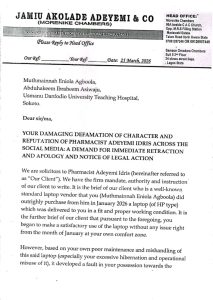
On March 25, 2026, a formal letter surfaced, which was typed on the letterhead of a legal chamber called Jamiu Akolade Adeyemi and Co. situated at Ilorin, Kwara State. The entire narrative was reframed. Where students spoke of defective systems and financial loss, the document spoke instead of reputation, injury, and defamation.
Addressed to at least one of the complainants named Miss Muthmainah Eniola, the letter demanded an immediate and total retraction of all allegations, alongside a public apology to be circulated across the same social media platforms where the claims had gained traction.
When Digest Press got hold of the letter, it did not merely dispute the accusations but it rejected them outrightly with compensation demanded.
Through his legal representatives, the seller, Idris Adeyemi maintained that the laptop in question had been delivered in a fit and proper working condition, insisting that any faults that later emerged were not inherent defects, but consequences of poor maintenance and misuse by the buyer.
In this narration, “the problem was not the product but the hands that held it and used it.” he said.
But the letter went further to characterize the students’ demands for refunds or replacements not as legitimate complaints, but as acts of coercion; an attempt, it was suggested, to have put pressure on the seller into concessions, which he was not obligated to make.
The tone sharpened as it warned Miss Muthmainah that failure to comply with its demands would trigger legal consequences, both civil and criminal.
Beyond the legal correspondence sent by the seller, direct attempts to obtain further clarification from Mr Adeyemi returned abortive as he directed this reporter to speak with his lawyer. An attempt to reach his lawyer returned unsuccessful as he failed to attend to both calls and messages sent to his line as at the time of filing this report.

In a twist of events, the number, connected to one Lawyer Jamiu Adeyemi, sent by the seller as his lawyer’s number turned out to be a number that had earlier called to threaten this reporter and warn him not to get involved or he will face the consequences.
“You don’t need to get yourself involved in a matter regarding defamation.” the voice warned. Bridging the barrier between us, from the other end of the line.